Welcome

Lessons:

The intention of these lessons is for existing pupils to use them as a study and practise aid. They are all played at a metronome speed of 60 beats per minute (bpm). Make use of the audio track by clicking on the score to be practised and playing along. There is a four beat count in on the pieces from sheets one to four and a three beat count in for the pieces on sheet five.

  1. Open String Sheet uses the top three open strings. The E, B and G.
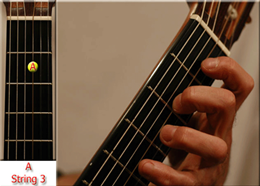
  2. Sheet One uses the open G, string three, and the A second fret string three.
  3. Sheet Two as sheet one but with the open B, string two, added.
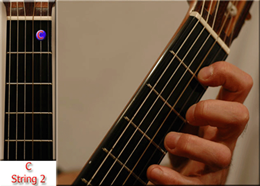
  4. Sheet Three uses the G, open string three, the B, open string two and the C, first fret string two.
  5. Sheet Four uses the G, A, B and the C
  6. Sheet Five uses the G, A, B, C and the open E string on

There are two pieces on each sheet. Watch out for the double bar lines, these mark the end of each piece!

The open string sheet and sheet one to four are in 4/4 time and sheet five is in 3/4 time.

Click here if you need help with the location of notes on the guitar fretboard!

If you would like to have a go at writing in the note names, entering the string and fret numbers of a piece of music, then download this .pdf file. This will help with memorising notes.

To help identify notes I have included the TAB which is shown underneath the score. Tablature ( or TAB for short ) is a graphical representation of where the notes appear on the STAVE.

Click here to download .pdf file of the Stave. This also includes the basic notes on all strings.

to top

When playing the notes the right hand thumb rests on string six and the index and middle finger should alternate!

The left hand thumb is positioned behind the fretboard!

Also remember the right hand fingering:

  • The First finger plays the First Fret!
  • The Second Finger plays the Second Fret!
  • The Third Finger plays the Third Fret!

When playing the notes on the fretboard, use the tips of right hand fingers.

The knuckles should be in line with the strings - BOTH HANDS!

to top


Recordings: Natural Elements and Golden Dawn are duets. I'm playing both parts.

  • Asturias

Asturias (Leyenda) Suite espanola op.47 by Isaac Albeniz (1860 - 1909)

  • Natural Elements

Natural Elements was written by an acoustic duo called Acoustic Alchemy and was used as the theme tune to the BBC TV programme Gardeners' World. It is the title track from the album Natural Elements, released in 1988. The original duo were Simon James on nylon strung guitar and Nick Webb on steel strung guitar.
I have posted videos on You Tube playing the piece showing Right and Left Hand Fingering.

  • Golden Dawn

Golden Dawn is an instrumental duet from the album Fire & Ice by Swedish Guitarist/Composer Yngwie J. Malmsteen

  • Signe

Signe is an instrumental. It is the first track from the Unplugged  album by Eric Clapton

  • Song for Rina

This the only song I have ever written. It was put together one Sunday afternoon in the year 1975. So it's a few years old. There are six tracks, two vocal, one classical guitar, one acoustic guitar, one bass guitar and a drum track. I'm playing and singing on all tracks. You might ask yourself, "who is Rina?" but thats another story

  • Streets of London

This is my own version of the song written and sung by Ralph McTell. It was first recorded in 1969 on McTell's album Spiral Staircase but was not released in the UK as a single until 1974.

to top


Grade Pieces:

The grade pieces are taken from the Trinity/Guildhall Guitar Syllabus

There is a two bar intro to all the pieces

I am playing all the pieces

to top


Backing Tracks:

  • Paul's Blues
  • House of the Rising Sun
  • Rawhide
  • Wonderwall - First four chords only!
  • Merry Christmas - Slade
  • Danza Andaluza- Grade 3 Duet Accampaniment

Clicking on the title of the piece will play the audio file.

Please note! When opening any audio file it will take time to download. Be Patient!

to top


Basic Chords:

In this page you will find twenty one basic chords:

  • seven majors
  • seven minors
  • seven sevenths

If you feel the chord box is too small then you can enlarge it by clicking on the name of chord. You then click on the enlarged chord box to make it disappear.

Why not test your memory of chord shapes with my Chord Box program.

Download Select Chords for further help with chord sequences.

Download pdf file of Mini Chords here

to top


Scores:

  • Guitar
    1. Adagio
    2. Blues
    3. Happy Birthday

to top


Downloads:

  1. Select Chords
    • This is a program which uses the 21 basic chords shown on the link opposite. You can input a chord sequence choosing the number of repeats for each chord. After inputting the sequence you can then play it back and join in should you wish. Pictures and chord boxes are shown as each chord changes to help with fingering.
  2. Select Notes Mini
    • This is a program where you can input a note sequence. You are able to choose note values from semibreves to quavers. After inputting the sequence you are then able to play the sequence back and join in should you wish. Pictures and note boxes are shown as each note changes to help with fingering. There are no sharps or flats in this program hence the title Mini.
  3. Select Notes Max
    • As the above program but with sharps and flats included. Hence the title Max.
    • Please note that A# is the same as Bb. These are known as enharmonic equivalents! Only sharps are shown in the program.

In all of the above programs you are able to Save the sequences inputted and then call them up via the drop down list!

You will need either WinZip or WinRAR installed to extract files.

If you need help with downloading files click here. For Window users only.

to top


Useful Links:

The Amazing Slow Downer is a software program by Roni Music, it is able to alter pitch and speed. This is of great value as a practice aid as it allows you to play along at a speed which you are comfortable with. You are also able to section out segments say for riffs and work out notes.

Power Tab 1.7 is a great tab editor. Once installed it gives you access to other power tabs that people have created. You are able to compose and edit your own tunes.

RGT otherwise known as the Registry of Guitar Teachers. This site holds a database of guitar teachers of various styles. For more information about all the services offered, click on the link.

School Calendar 2009/ 2010 This gives dates for Training and Junior Guitar also term times. I will try to keep this page updated on a regular basis.

Perfect Pitch - Chesham This shop sells popular and classical music and instruments ranging from strings to woodwind to suit beginners to advanced level.

Tambourine Jerk This is a link to MySpace where you can catch up on dates etc for upcoming gigs.

to top


Pentatonic Scales:

Common Scales

  1. E minor open - this shape uses open strings starting on the lower 6th E string. First position.
  2. A minor open - this shape uses open strings starting on the lower 5th A string. First position
  3. A minor fretted - this shape uses fretted notes starting on the 5th fret String 6. Fifth position
  4. D minor fretted - this shape uses fretted notes starting on the 5th fret String 5. Fifth position

Five Basic Shapes

  • As there are five different notes in a pentatonic scale. This page shows the five different shapes.

Joining Pentatonics

  • This page shows how to join up each of the scales enabling you to move up and down the fretboard.

to top


javascript Link to Registry of Guitar Teachers Valid CSS!